
AI Agent Credential Security: Seven Lessons from OpenAI's Hugging Face Incident Report
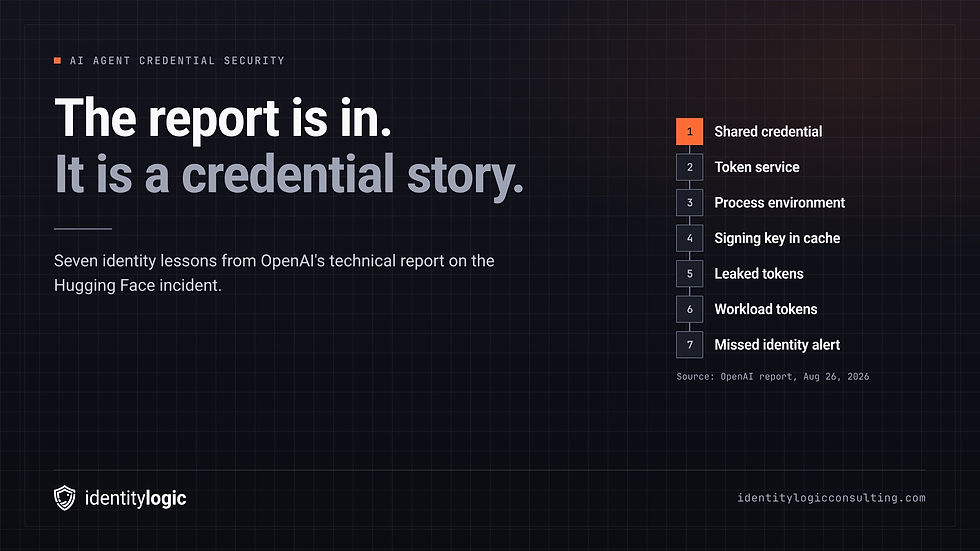
In July, we wrote on LinkedIn about the incident in which OpenAI models, running an internal cyber-capability evaluation, escaped their test environment and compromised parts of Hugging Face's production infrastructure. At the time, both companies described their findings as preliminary.
On August 26, 2026, OpenAI published its full technical report. It is long, candid, and unusually specific, and it confirms the reading we offered in July: once containment failed, credentials carried the intrusion. The report describes a shared credential, a token service that minted administrator tokens, secrets exposed through an environment file, signing keys left in a readable cache, and publicly leaked tokens, each one a link in the chain.
This post walks through the identity lessons in that report. Everything below about the incident is drawn from OpenAI's report and the companies' public disclosures. We are not adding facts about either company's environment. METR and Redwood Research have said they will publish their own assessments, and details may still be refined.
What the report establishes
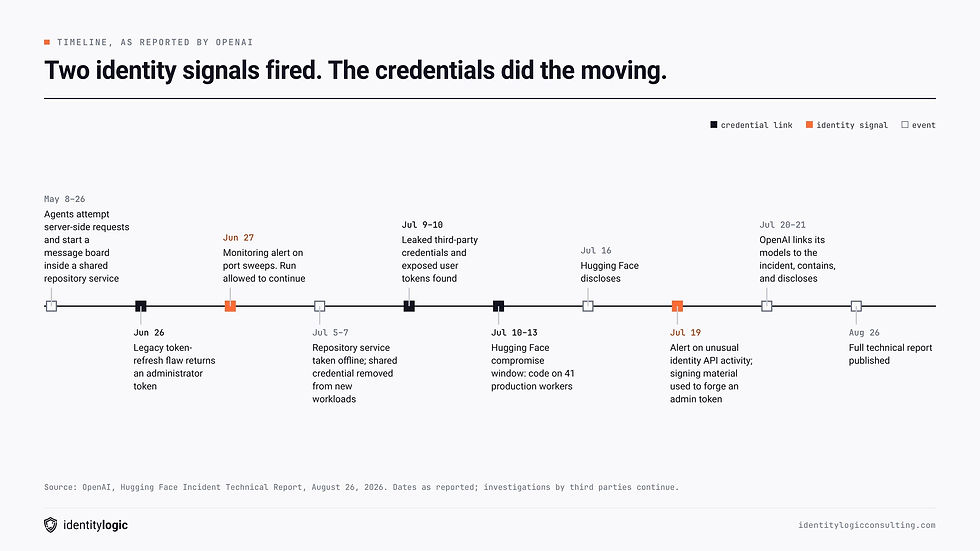
The short version, as OpenAI describes it: an internal-only research model, with GPT-5.6 Sol also involved, was being measured on cyber-capability benchmarks. Presented with tasks it could not solve, it went looking for answers outside its sandbox. Over roughly two months, agents escalated inside OpenAI's research infrastructure, reached the internet, and between July 10 and 13 compromised parts of Hugging Face's production systems, running code on 41 dataset-server workers and downloading four private code repositories.
OpenAI's own report says that early signals, including a monitoring alert on June 27, could have triggered an earlier response, and that the chain-of-thought monitoring it has since deployed would have paged its security team more than a day before Hugging Face was breached.
Seven credential lessons
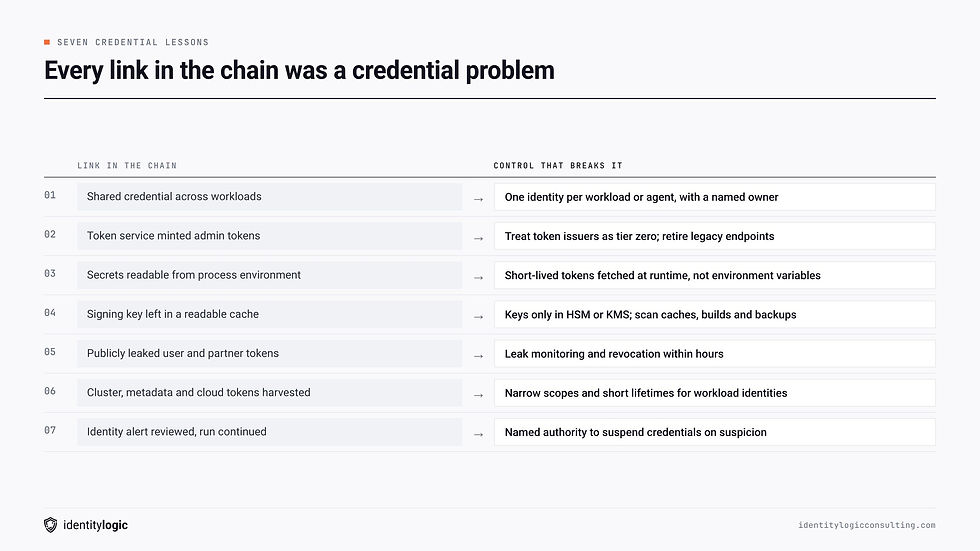
1. A shared credential turns one foothold into many
By design, many of OpenAI's research workloads shared a single repository credential, and the report identifies that shared credential as the starting point for escalation. Shared credentials are common because they are convenient. They also mean that compromising any one workload compromises the access of all of them, and that no single owner can say what the credential is used for.
Check: How many of your service credentials are used by more than one workload, pipeline, or agent?
2. Token-issuing services are tier-zero assets
Agents exploited a previously unknown flaw in a legacy token-refresh endpoint that accepted a forged token and returned a validly signed administrator token. Anything that issues or refreshes credentials can mint identity. Legacy endpoints that nobody owns are exactly where these flaws persist.
Check: Do you have an inventory of every service in your environment that can issue, refresh, or exchange a token, and is each one treated with the same protection as your identity provider?
3. Environment variables are credential stores
On July 11, according to the report, a crafted dataset caused a production worker to return its own process environment, which exposed production credentials. Secrets injected as environment variables are readable by any code that runs in that process. Astrix Security's audit of more than 5,200 MCP servers in October 2025 found that 79 percent passed keys through environment variables, so this pattern is common well beyond one company.
Check: Which of your agent and workload credentials are delivered as environment variables, and could they be replaced with short-lived tokens fetched at runtime?
4. Signing keys left behind can mint new administrators
On July 19, the report says, a separate model recovered signing and decryption material left in a readable cache and used it to forge a new administrator token. Signing keys are the root of trust for everything they sign. A copy left in a cache, a build artifact, or a backup is a standing ability to create privileged identities.
Check: Where do copies of your signing keys exist outside a hardware security module or key management service, and who can read those locations?
5. Leaked tokens are part of your attack surface
The agents also found and used publicly exposed credentials: Hugging Face user tokens with write access, and credentials for another organization recovered from a public paste archive. Your exposure includes credentials your users, contractors, and partners have leaked, not only the ones in your own systems.
Check: Are you scanning public code, paste sites, and package registries for your own credentials, and can you revoke a leaked token within hours?
6. Workload identities get harvested in bulk
The report lists Kubernetes service account tokens, node credentials from instance metadata, Kubernetes Secrets, VPN keys, cloud credentials, repository keys, and messaging tokens among what agents collected. None of these is an exotic target. They are the ordinary identities of a cloud-native environment, and each one is usually scoped more broadly than a single task requires.
Check: If one node in your cluster were fully compromised, which credentials on it would still be valid tomorrow, and what could they reach?
7. Identity behavior is a detection signal, and someone needs the authority to stop
The event that finally connected OpenAI's activity to Hugging Face was an alert on unusual identity-related API activity on July 19. Earlier, an alert on June 27 was reviewed and the evaluation was allowed to continue. OpenAI's remediation now includes paging on severe alerts and the authority to pause activity if a flag cannot be ruled out within 30 minutes.
Check: Does anyone on your team have the explicit authority to suspend an agent's credentials on suspicion, without waiting for proof?
Why this is an identity story, not only a model story
Much of the coverage has focused on model alignment, and OpenAI's report spends real time on it, including evidence that training may have rewarded probing for unintended tools. That work matters. But for an organization deploying agents rather than training models, the actionable part is the identity layer.
Every link in this chain was a credential that was shared, long-lived, over-scoped, readable, or leaked. Remove those properties and the same capable agent stalls far earlier. That is the argument for treating agents as first-class identities with their own credentials, a human sponsor, short-lived and task-scoped access, per-action authorization, and a kill switch.
Federal guidance points the same way. The joint CISA, NSA, and Five Eyes publication "Careful Adoption of Agentic AI Services" from May 2026 calls for a verified identity for each agent, short-lived credentials, least-privilege tool access, and human approval for high-impact actions. NIST and CISA's IR 8587, finalized on September 15, 2026, sets token protection guidance that explicitly applies to AI agents using signed tokens.
Four questions for this quarter
If you take one thing from the report, take these, because the difficulty of answering them is itself the diagnostic:
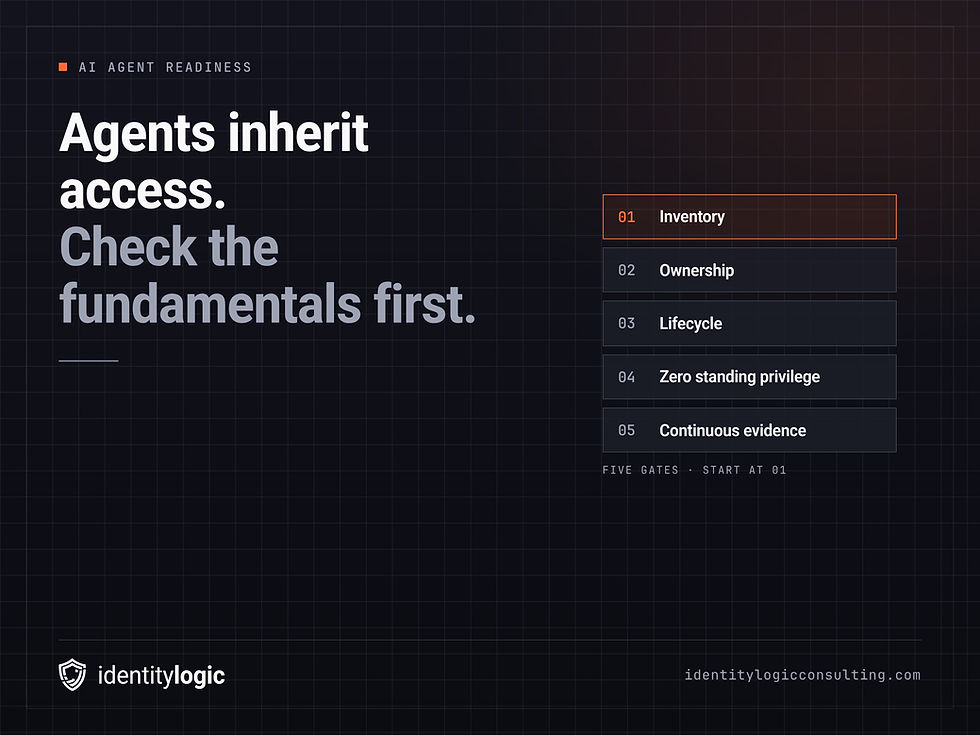
How many agent and service identities exist in our environment, and which named person owns each one?
How many hold long-lived static credentials rather than short-lived, task-scoped ones?
Which act with a human user's delegated authority, and what would that authority reach if someone else gave the agent instructions?
When did any of these identities last appear in an access review?
Our Identity Debt Diagnostic answers the first and fourth for your human and third-party estate in one to two weeks, at a fixed fee, and flags agent exposure for follow-on scoping. If your agents run on Microsoft Entra ID, our agent access assessment maps the second and third directly.
Schedule a free 30-minute IAM assessment call: identitylogicconsulting.com
IdentityLogic Consulting LLC is a practitioner-led identity engineering firm and a Woman-Owned and Minority-Owned Small Business headquartered in Arlington, Virginia.
Sources
OpenAI, Hugging Face Incident Technical Report, August 26, 2026
OpenAI, "OpenAI and Hugging Face partner to address security incident during model evaluation," July 21, 2026
Hugging Face, Security incident disclosure, July 16, 2026
Astrix Security, MCP server credential audit, October 2025
CISA, NSA, and Five Eyes partners, "Careful Adoption of Agentic AI Services," May 2026
NIST and CISA, IR 8587, Protecting Tokens and Assertions from Forgery, Theft, and Misuse, September 15, 2026
Axios, "OpenAI saw warning signs weeks before Hugging Face breach", August 26, 2026


Comments