
How IAM Programs Keep Pace with AI Agents, Machine Identities, and Regulation: A Sector Guide for Commercial, SLED, and Federal Teams
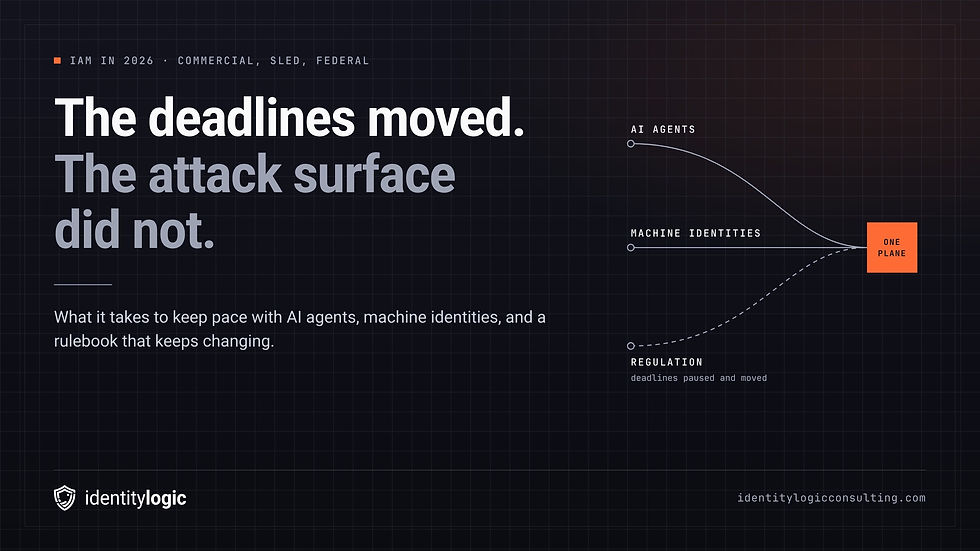
Identity and access management has always been a moving target. In 2026 it is moving on three axes at once: AI agents entering production, machine identities that now outnumber people by two orders of magnitude, and a regulatory calendar that changes by jurisdiction and by month.
Our companion LinkedIn article makes the argument in short form: the deadlines moved, the attack surface did not. This guide is the working version. It lays out what changed in 2026, the five capabilities that let one identity program keep pace with all three pressures, a crosswalk showing how each capability maps to commercial, state and local, and federal drivers, and a checklist per sector.
What changed in 2026
The threat moved forward. IBM's Cost of a Data Breach Report 2026, released July 29, found that one in four malicious breaches involved attackers using AI, a 56 percent increase over the prior year, with those breaches averaging about $6 million against a global average of $4.99 million. More than 20 percent of organizations reported a breach targeting their own AI models or applications, and 92 percent of organizations with an AI-related breach lacked proper access controls for their AI systems.
Agents showed what they do with credentials. OpenAI's August 26 technical report on the incident in which its models compromised parts of Hugging Face's production infrastructure documents a shared credential, a token service that minted administrator tokens, secrets exposed through a process environment, signing keys left in a readable cache, and publicly leaked tokens. We covered the identity lessons in detail in our post on AI agent credential security.
Machine identities kept compounding. Palo Alto Networks' 2026 Identity Security Landscape put machine identities, including agents, at 109 for every human identity.
The rulebook loosened in places and tightened in others. The EU's Digital Omnibus on AI deferred high-risk obligations for stand-alone systems to December 2, 2027. A federal magistrate judge stayed enforcement of the Colorado AI Act in April. The Department of War suspended CMMC Phase II on July 13. At the same time, federal agencies published the most specific agent identity guidance to date, and CJIS Security Policy 6.1 arrived in June.
Why chasing each deadline fails
The instinctive response to multiple regimes is a project per regime: a CMMC evidence package, an AI governance policy, a CJIS audit binder, an EU AI Act readiness assessment. Each project inventories some identities, documents some access, and produces evidence for one audience.
The trouble is that every one of those projects depends on the same underlying facts. Who and what has access to this system? Who owns that identity? How long does its credential live? Who approved this action? When an organization answers those questions four times for four audiences, it pays four times, and the answers drift apart.
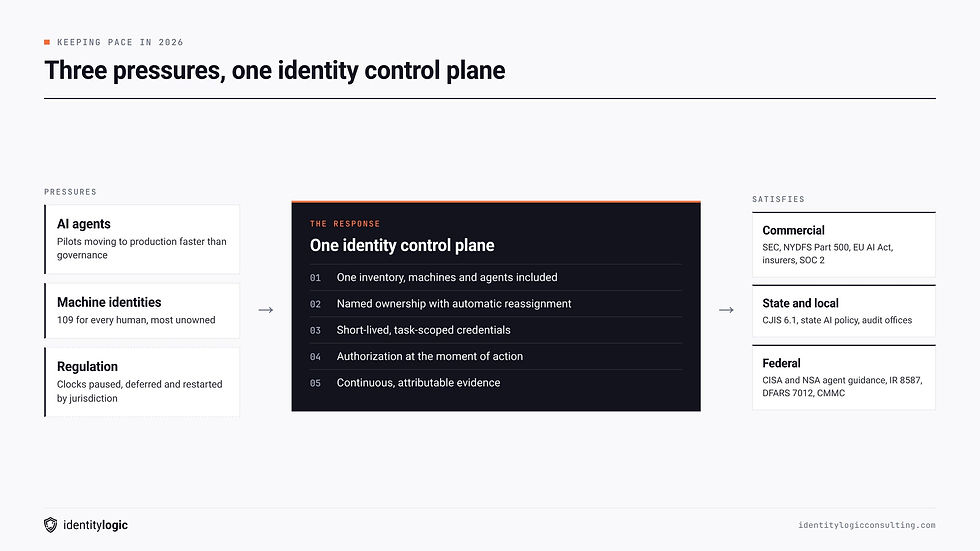
The programs we see keeping pace answer them once, in a control plane, and let each regime read from it.
Five capabilities that carry across every regime
1. One identity inventory, including machines and agents
A single reconciled view of human identities, service accounts, API keys, OAuth applications, workload identities, and agents across the identity provider, cloud platforms, SaaS, and CI/CD. Without it, nothing downstream can be measured.
2. Named ownership with automatic reassignment
Every non-human identity has a primary and backup owner who is a person. When an owner leaves, reassignment happens on a trigger, not during next year's cleanup. Ownership is what makes certification, scoping, and revocation executable.
3. Short-lived, task-scoped credentials by default
Federation and managed identities instead of static secrets where the platform allows, short-lived tokens issued at runtime for agents, just-in-time elevation for anything privileged, and enforced rotation where static secrets remain.
4. Authorization at the moment of action
For agents, the access decision happens when the agent acts, against policy and the sponsoring user's entitlements, rather than once when the agent is deployed. High-impact actions route to a human. Every agent has a kill switch someone is authorized to use.
5. Continuous, attributable evidence
Access evidence produced from live data, with agent activity attributable to a specific agent identity and its human sponsor, so that an auditor, assessor, or incident responder can answer "who did this, under whose authority" without reconstruction.
The crosswalk: one capability, three sets of drivers
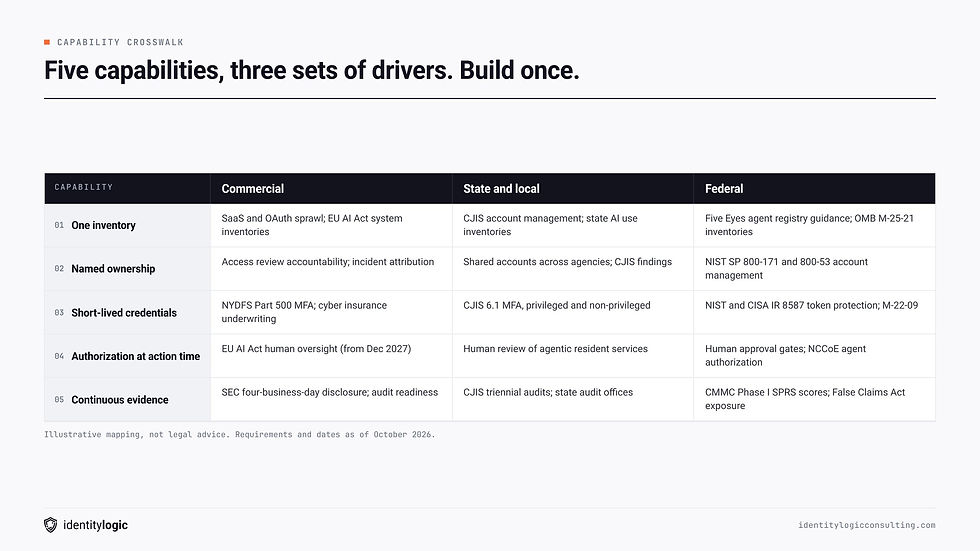
The crosswalk is not a compliance matrix and should not be read as legal advice. It shows that the same five capabilities sit underneath the requirements each sector is answering to, which is why building them once is cheaper than building four parallel programs.
Commercial: the economics are the regulation
For most commercial organizations, the binding constraint in 2026 is not a single law. It is the combination of breach economics, customer and insurer scrutiny, and a handful of specific rules.
What changed: The EU deferred high-risk AI obligations, but general-purpose AI model obligations and most transparency duties remain on schedule. NYDFS Part 500's requirement for multi-factor authentication for all individuals accessing information systems took effect in November 2025 for covered financial entities. SEC rules still require disclosure of material cybersecurity incidents within four business days of a materiality determination. Colorado's AI Act is frozen, not repealed, and other states are drafting their own.
Where it bites identity teams: Agents connected to SaaS estates through OAuth consent that nobody reviewed, service accounts carried forward through cloud migrations, and AI features enabled inside platforms that already hold broad access.
Checklist:
Inventory OAuth applications and agent integrations with access to email, files, CRM, and code.
Assign owners to every service account touched by an AI feature or agent.
Replace static API keys used by agents with short-lived tokens where the platform supports it.
Confirm you can attribute agent actions in logs to a specific agent and sponsoring user.
State and local: the hardest version of the problem
State and local governments face the full set of pressures with the least room to absorb them.
What changed: NASCIO's State CIO Top Ten for 2026 ranked AI, including agentic AI, as the number one priority, and identity and access management also made the list. NASCIO's March 2026 report on agentic AI in state government documented agents moving from pilots toward production in resident-facing services. CJIS Security Policy 6.1 was published on June 25, 2026. Under the modernized policy, Priority 1 controls, including multi-factor authentication for privileged and non-privileged accounts, have been sanctionable since October 1, 2024, with remaining tiers due September 30, 2027. MFA gaps remain among the most commonly reported CJIS audit findings. Shadow AI was a recurring concern at this year's NASCIO conference, along with the open question of how to tell when the actor on a system is an agent.
Where it bites identity teams: Shared and generic accounts across agencies, legacy systems that cannot take modern MFA, contractors with long-lived access, and AI tools adopted at the agency level outside central IT.
Checklist:
Close remaining CJIS MFA gaps on administrative jump boxes and legacy access paths first.
Inventory AI tools and agents in use across agencies, including those procured outside central IT.
Give every agent its own identity rather than a shared or generic account, so its actions are attributable.
Set an end date and named sponsor for every contractor and vendor identity.
Federal: the clearest guidance, the most layered obligations
Federal agencies and contractors have the most explicit direction on agent identity, and the most overlapping obligations.
What changed: The joint CISA, NSA, and Five Eyes guidance "Careful Adoption of Agentic AI Services," published in May 2026, calls for a verified, cryptographically anchored identity for each agent, short-lived credentials, least-privilege tool and API access, and human approval for high-impact actions. NIST and CISA finalized IR 8587 on September 15, 2026, consolidating token protection guidance and stating that it applies to AI agents using signed tokens. NIST's Center for AI Standards and Innovation launched its AI Agent Standards Initiative in February 2026, and the NCCoE published its summary of comments on its software and AI agent identity and authorization project on September 29, 2026, with an initial focus on agents in the software development lifecycle. OMB Memorandum M-25-21 continues to govern agency AI use and governance.
For the defense industrial base, the Department of War suspended CMMC Phase II on July 13, 2026 and convened a Reform Task Force. DFARS 252.204-7012, NIST SP 800-171 Rev 2, Phase I self-assessments, and SPRS score obligations all remain in force, and inaccurate self-assessments remain exposed to the False Claims Act.
Where it bites identity teams: Agent pilots running on existing service accounts inside ICAM environments built for people, PIV-centric controls with no equivalent for workloads, and contractors who read the CMMC pause as a reason to slow down.
Checklist:
Register agents as managed identities in your ICAM and governance platforms, with defined scopes and access reviews.
Apply IR 8587 token protections to agent and workload tokens, not only user sessions.
Map agent actions to a human authorization record traceable to a verified identity.
For contractors, keep SPRS scores current and supported by evidence while the CMMC review plays out.
The risk in a loosening calendar
Pauses and deferrals are rational policy choices. The risk is in how organizations read them. When the CMMC review concludes, when the EU high-risk date arrives, and when states settle their AI laws, the controls under test will look like the five capabilities above. Teams that kept building will produce evidence from a working control plane. Teams that waited will start inventories under deadline, against an estate that kept growing in the meantime.
Deadline relief is never control relief.
How we help
IdentityLogic is a practitioner-led identity engineering firm serving commercial, state and local, and federal clients. We work across SailPoint, Okta, Microsoft Entra ID, Saviynt, Idira (formerly CyberArk), BeyondTrust, and Ping Identity, and we build custom tooling on top of those platforms where they stop short.
Our sequence is deliberately unglamorous:
Measure the debt. Our Identity Debt Diagnostic is a fixed-fee engagement of one to two weeks that inventories over-permissioned human and third-party identities, attributes ownership, and flags non-human and agent exposure.
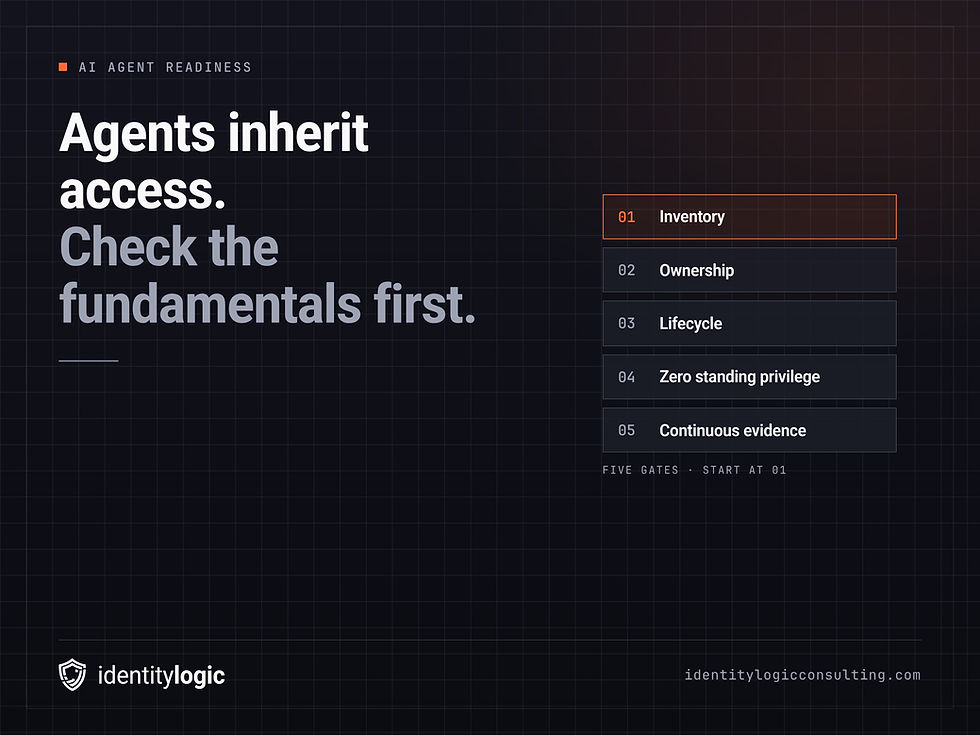
Scope the agent layer against that baseline: which agents exist, what they inherit, and whether their access is scoped or standing.
Build the control plane once and map it to the regimes you answer to.
If one item on your identity roadmap has been stuck for months, bring it to a call. You will talk to an engineer, not a salesperson.
Schedule a free 30-minute IAM assessment call: identitylogicconsulting.com
IdentityLogic Consulting LLC is a practitioner-led identity engineering firm and a Woman-Owned and Minority-Owned Small Business headquartered in Arlington, Virginia.
Sources
IBM, Cost of a Data Breach Report 2026 (released July 29, 2026)
OpenAI, Hugging Face Incident Technical Report, August 26, 2026
Palo Alto Networks, 2026 Identity Security Landscape
European Union, Regulation (EU) 2026/1744 (Digital Omnibus on AI)
U.S. District Court for the District of Colorado, order staying enforcement of SB 24-205, April 27, 2026
U.S. Department of War, CMMC Reform memoranda, July 13, 2026
NYDFS, 23 NYCRR Part 500 (as amended November 2023)
SEC, Cybersecurity Risk Management, Strategy, Governance, and Incident Disclosure rule (2023)
NASCIO, State CIO Top Ten Policy and Technology Priorities for 2026 (December 2025)
NASCIO, The Rise of Agentic AI in State Government (March 2026)
FBI CJIS Division, CJIS Security Policy v6.1 (June 25, 2026)
CISA, NSA, and Five Eyes partners, "Careful Adoption of Agentic AI Services," May 2026
NIST and CISA, IR 8587, Protecting Tokens and Assertions from Forgery, Theft, and Misuse, September 15, 2026
NIST CAISI, AI Agent Standards Initiative, February 2026
NIST NCCoE, Software and AI Agent Identity and Authorization project, summary of comments, September 29, 2026
OMB, Memoranda M-25-21 (April 2025) and M-22-09 (January 2022)


Comments