
The Stryker Breach: A CISA Wake-Up Call Every Enterprise Should Heed

How the Iran-linked attack on a Fortune 500 medical device leader exposes critical gaps in privileged access management — and why CISA's response roadmap maps directly to proven Identity Access Management solutions.
The Attack Vector That Changed the Conversation
On March 11, 2026, the Iran-linked Handala hacktivist group accomplished what many security professionals considered a nightmare scenario: complete administrative takeover of a Fortune 500 enterprise through a single compromised Global Admin account. The target was Stryker Corporation, the $25 billion medical device manufacturer with 56,000 employees across 79 countries.
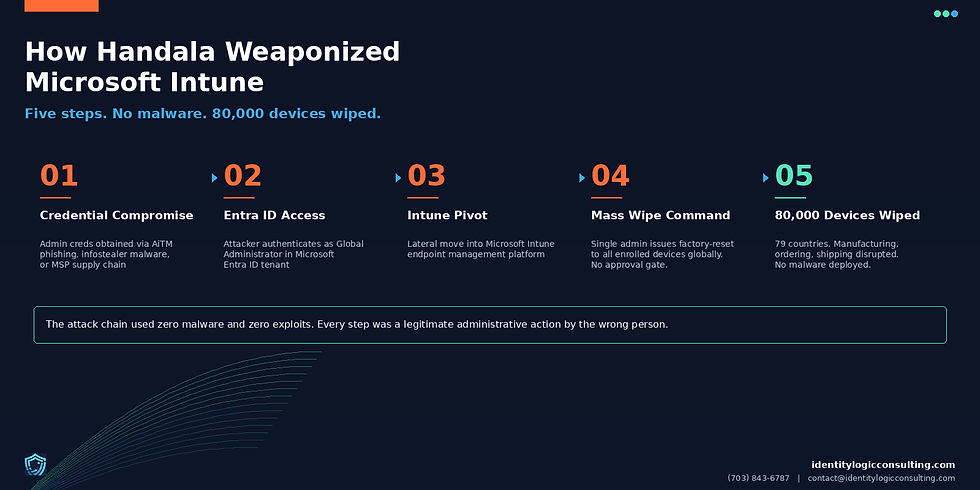
The attack was devastating not because of malware or ransomware deployment, but because of what the attackers did with legitimate administrative tools. After compromising Microsoft Entra ID Global Admin credentials through an adversary-in-the-middle (AiTM) phishing attack, Handala used Stryker's own Microsoft Intune deployment to remotely wipe between 80,000 and 200,000 corporate devices globally.
No sophisticated tools. No zero-day exploits. Just privileged account abuse at scale.

The immediate business impact was severe: supply chain disruptions, surgical procedure delays, and Stryker stock declining 12% in post-breach trading. But the broader industry impact was arguably more significant: the attack demonstrated how modern cloud-based device management platforms can be weaponized when privileged access controls are insufficient.

CISA's Response: A Roadmap for Enterprise Action
Seven days after the attack, the U.S. Cybersecurity and Infrastructure Security Agency (CISA) issued emergency advisory AA26-078A, warning all American organizations to immediately harden their endpoint management systems. The advisory wasn't theoretical — it was based on active threat intelligence from an ongoing attack affecting critical infrastructure.
CISA's recommendations center on four core principles:

1. Implement Least-Privilege Administrative Roles
CISA Guidance: "Organizations should apply the principle of least privilege when designing administrative roles, ensuring that users are granted only the access necessary to perform their tasks."
The Stryker breach occurred because Global Admin accounts possessed unrestricted privileges across the entire Microsoft environment. This level of access is rarely necessary for day-to-day operations but creates catastrophic risk when compromised.
IdentityLogic Solution Path: Privileged Access Management (PAM) architecture and implementation using industry-leading platforms like BeyondTrust and CyberArk. Our PAM consulting engagements typically reduce privileged account exposure by 60-80% through:
Just-in-time privilege elevation
Session recording and monitoring
Automated secret rotation
Administrative account segregation

2. Enforce Multi-Admin Approval for High-Impact Operations
CISA Guidance: "Implement multi-admin approval through access policies, ensuring that sensitive or high-impact changes (such as wiping devices) require a second administrator's approval."
Stryker's Intune environment allowed single-administrator device wipes across thousands of endpoints simultaneously. This design pattern, while operationally convenient, creates single points of failure for critical security operations.
IdentityLogic Solution Path: Identity Governance & Administration (IGA) policy design with separation of duties controls. Using platforms like SailPoint IdentityIQ and ISC, we implement approval workflows that require:
Multi-person authorization for privileged operations
Manager approval for elevated access requests
Automated time-bound access provisioning
Compliance reporting and audit trails

3. Deploy Phishing-Resistant Multi-Factor Authentication
CISA Guidance: "Implement phishing-resistant multi-factor authentication to prevent unauthorized access and strengthen identity security."
The initial Stryker compromise succeeded through AiTM phishing, which defeats traditional SMS and application-based MFA by intercepting session tokens. CISA specifically recommends FIDO2, PIV, and certificate-based authentication that cannot be phished.
IdentityLogic Solution Path: Advanced authentication architecture using Microsoft Entra ID Conditional Access, Windows Hello for Business, and FIDO2 security keys. Our authentication projects deliver:
Risk-based access policies
Device trust integration
Continuous authentication monitoring
Legacy system SSO consolidation

4. Monitor and Alert on Mass Device Operations
CISA Guidance: "Establish monitoring and alerting for mass device operations to detect and respond to potential misuse of endpoint management tools."
Enterprise endpoint management platforms like Intune, VMware Workspace ONE, and IBM MaaS360 are designed for scale — they can deploy configurations or wipe devices across thousands of endpoints rapidly. This operational capability requires proportional monitoring and alerting.
IdentityLogic Solution Path: Identity threat detection and response (ITDR) using Microsoft 365 Defender, Okta ThreatInsight, and SailPoint SaaS security analytics. Our monitoring implementations include:
Behavioral analytics for administrative accounts
Mass-operation alerting and automated response
Integration with SIEM platforms
Real-time risk scoring and escalation
Why the Stryker Breach Matters for Your Organization
The Handala attack on Stryker represents a fundamental shift in enterprise threat modeling. Traditional security controls focused on preventing unauthorized access to networks and applications. The Stryker breach demonstrates that authorized access — when improperly governed — can be equally destructive.
Consider the business impact vectors:
Operational Continuity: 200,000 wiped devices across 79 countries created immediate workforce disruption affecting manufacturing, sales, and support operations.
Revenue Impact: Medical device sales and service delivery were compromised, directly affecting patient care and revenue recognition.
Compliance Exposure: Healthcare device manufacturers operate under strict FDA regulations. System outages affecting patient safety create regulatory investigation risk.
Brand Reputation: The attack received extensive media coverage, associating Stryker with security failure in highly regulated industry contexts.
Recovery Costs: Device replacement, data restoration, forensic investigation, and business continuity activation create immediate financial impact before considering longer-term business losses.
Most enterprises using Microsoft 365, Azure, or similar cloud platforms have similar exposure profiles. The difference between Stryker and other potential targets may simply be threat actor motivation and timing.
The Federal Government Response: Executive Order Implications

The Stryker breach occurred during escalating Middle East tensions, highlighting the intersection of geopolitical conflict and enterprise cybersecurity. The Biden administration has signaled that critical infrastructure protection — including healthcare supply chains — represents a national security priority.
Federal agencies are implementing zero trust architecture mandates that require:
Identity-centric security controls
Least-privilege access policies
Continuous monitoring and verification
Cloud-native security tool integration
These requirements create compliance pressure for federal contractors and healthcare organizations that serves as a leading indicator for broader enterprise adoption.
Private sector organizations that implement CISA-recommended controls proactively may find themselves better positioned for federal contract opportunities that increasingly require demonstrated zero trust compliance.
Implementation Roadmap: From Stryker Lessons to Enterprise Protection
Based on CISA's advisory and the Stryker attack pattern, enterprises should prioritize identity security investments in this order:

Phase 1: Immediate Risk Reduction (30-60 days)
Privileged Account Audit: Inventory all Global Admin, Enterprise Admin, and equivalent high-privilege accounts across Azure, AWS, Google Cloud, and enterprise applications.
MFA Upgrade: Replace SMS and app-based MFA with FIDO2 or certificate-based authentication for all administrative accounts.
Access Review: Conduct emergency access certification for all privileged accounts, removing unnecessary permissions and dormant accounts.
Phase 2: Control Implementation (90-180 days)
PAM Deployment: Implement dedicated privileged access management for break-glass accounts and administrative access to critical systems.
Conditional Access: Deploy risk-based access controls that consider user, device, application, and network context for access decisions.
Monitoring Integration: Enable administrative action logging and alerting across all identity providers and endpoint management platforms.
Phase 3: Program Maturation (6-12 months)
IGA Platform: Deploy comprehensive identity governance with automated provisioning, access reviews, and compliance reporting.
Zero Trust Architecture: Implement identity-centric security policies that verify every access request regardless of location or device.
Continuous Improvement: Establish metrics, regular assessments, and threat intelligence integration for ongoing program enhancement.
Why IdentityLogic for Post-Stryker Identity Security
IdentityLogic Consulting specializes in the exact technology stack and implementation approach that CISA recommends in response to the Stryker breach. Our team has delivered SailPoint, BeyondTrust, and Microsoft identity solutions for enterprise clients.
IAM Specialization: We specialize exclusively in identity and access management, providing deeper expertise than generalist consultancies or platform vendors with broader portfolios.
Proven Implementation Experience: Our certified architects have deployed PAM, IGA, and advanced authentication solutions in regulated industries including healthcare, financial services, and government.
Vendor-Agnostic Approach: We recommend the best-fit technology for your environment rather than promoting specific vendor relationships, ensuring objective solution design.
Rapid Deployment Capability: Our proven methodologies enable 90-day PAM implementations and 180-day IGA deployments that deliver immediate risk reduction.
Ongoing Support Options: We provide managed services, staff augmentation, and fractional CISO support to ensure sustainable program success.
The Bottom Line: Executive Action Required
The Stryker breach demonstrates that enterprise identity security has evolved from IT concern to board-level business risk. CISA's response roadmap provides a clear framework for action, but implementation requires specialized expertise and executive commitment.
Organizations that treat the Stryker incident as a wake-up call and implement CISA's recommendations will be better positioned to prevent similar attacks, maintain operational resilience, and meet evolving compliance requirements.
Organizations that delay action may find themselves in Stryker's position: explaining to stakeholders, regulators, and customers how a single compromised account created enterprise-wide business disruption.
The choice is clear. The question is timing.
Contact IdentityLogic Consulting for a free 30-minute IAM security assessment focused on post-Stryker recommendations.
IdentityLogic Consulting LLC
1530 Wilson Blvd, Suite 650 Arlington, VA 22209 (703) 843-6787
About IdentityLogic Consulting: We are a practitioner-led identity security services firm. A decade of enterprise IAM delivery across Fortune 500 insurance, a global technology enterprise, and a major western utility, spanning identity governance, access management, privileged access, and program advisory.


Comments