
Identity Vulnerabilities in Popular Platforms: Why Zero Trust Architecture Matters More Than Ever

The most damaging enterprise breaches of the last eighteen months did not start with malware or network intrusion. They started with an identity. The platforms enterprises rely on to manage identity, Okta, Entra ID, SailPoint, CyberArk, and others, have become the primary target. The architectural answer is Zero Trust, and most enterprise programs are nowhere near it.
In the last eighteen months, the most damaging breaches did not start with malware on an endpoint or a network firewall misconfiguration. They started with an identity.
Change Healthcare in 2024: a Citrix portal with no MFA, 190 million records exposed. Conduent in 2025: a supply-chain compromise that exposed 25 million records. Hims & Hers in 2026: Okta SSO defeated by social engineering, customer data exfiltrated through Zendesk. Stryker, per CISA Advisory AA26-078A in March 2026: Entra ID Global Administrator accounts abused as the primary attack path. ShinyHunters, throughout 2026: a vishing campaign that walked into ADT, Mercer Advisors, Figure Technology, and Pathstone Family Office through help-desk calls.
Five separate incidents. Five different industries. One pattern. The perimeter that failed was the identity perimeter.
Where the platforms break
The identity platforms most enterprises rely on are not insecure in isolation. They break under three conditions that show up over and over in breach forensics.
Identity providers as the new front door
Okta, Entra ID, Ping, and similar platforms have become the single point of authentication for hundreds of downstream applications. That consolidation is a security win when it is configured well, and a catastrophic single point of failure when it is not. Social engineering against the help desk, session token theft, and OAuth consent phishing all bypass MFA without breaking it.
Privileged accounts without monitoring
The Stryker incident did not involve novel malware. It involved a Global Administrator in Entra ID being used the way Global Administrators are designed to be used. There was no real-time detection because there was no behavioral baseline. PAM tools like CyberArk, BeyondTrust, and Delinea exist to solve this, but they only work if privileged sessions actually flow through them. The most common failure we see in assessments: privileged accounts that exist outside the PAM vault entirely.
Identity governance that runs once a year
Most enterprises run access reviews quarterly at best. SailPoint and Saviynt can certify access far more frequently, but governance programs default to the minimum cadence the auditor will accept. The result: orphaned accounts, accumulated entitlements, and former contractors with active access nine months after their engagement ended. Eighty percent of breaches now involve stolen or misused credentials, and the average detection time is forty-seven days. Both numbers point to the same gap.
Why Zero Trust is the architectural answer
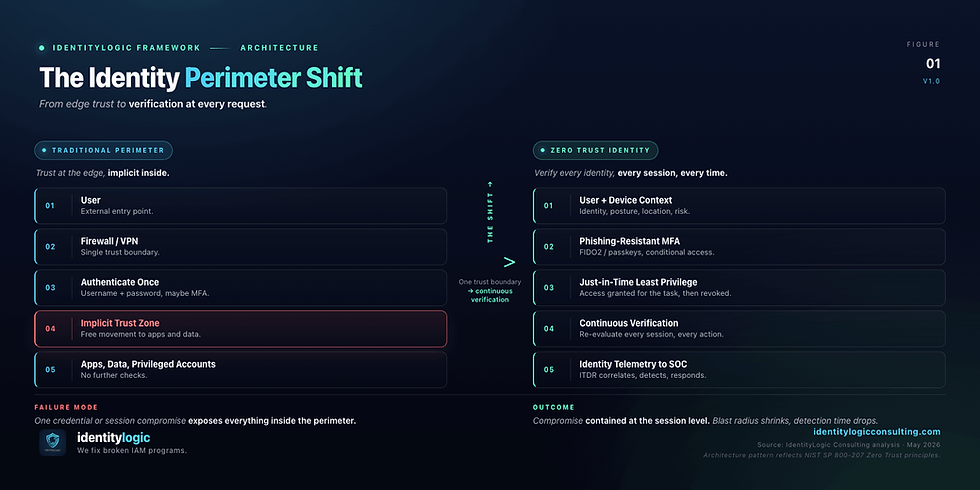
Zero Trust gets reduced to a slogan in vendor marketing, but the underlying principle is concrete and operational. The traditional perimeter assumed that anything inside the network was trusted. Zero Trust assumes nothing is trusted, including authenticated sessions, including privileged accounts, including service identities.
For identity specifically, Zero Trust means four shifts.
Continuous verification replaces point-in-time authentication. A session that was valid at login can be invalidated mid-session if device posture changes, location shifts, or behavior deviates from the user's baseline. This is what defeats stolen session tokens.
Least privilege becomes dynamic, not static. Access is granted just-in-time for the duration of the task, not provisioned permanently and reviewed quarterly. This is what shrinks the blast radius of a compromised account.
Every identity is verified, including non-human ones. Service accounts, API keys, and increasingly AI agents now outnumber human identities in most enterprises. If the agent does not know whose identity it is using, neither does the audit log. This is what closes the gap most breach investigations now uncover.
Identity telemetry feeds detection. Authentication logs, entitlement changes, and privileged session activity become primary inputs to the SOC, not afterthoughts. This is what cuts detection time.
What it looks like in practice
Zero Trust for identity is not a product. It is a program. Architecturally, it requires four capabilities working together.
A modern identity provider with phishing-resistant MFA, configured to enforce conditional access based on device, location, and risk score. FIDO2 or passkeys for high-risk roles. Help-desk procedures hardened against vishing.
A privileged access management platform with all privileged sessions routed through the vault, session recording enabled, and just-in-time elevation replacing standing admin rights. No exceptions for "break-glass" accounts that quietly become standing access.
An identity governance platform with monthly or event-driven certifications for high-risk entitlements, automated joiner-mover-leaver workflows, and integration with HR as the system of record. Orphaned accounts surfaced and remediated in days, not quarters.
An identity threat detection capability that correlates events across the identity stack and feeds the SOC. The platforms exist; the integration work usually does not get done.
The gap most programs do not see
Most enterprise identity programs have at least three of those four capabilities licensed. The platforms are not the problem. The integration, configuration, and operational discipline are. We see SailPoint deployments that never moved past the initial production cut. We see CyberArk vaults with sixty percent of privileged accounts outside the vault. We see Okta tenants with conditional access policies that exempt half the user base for convenience.
Zero Trust is not a procurement decision. It is an architectural decision, followed by years of governance discipline. The breaches above happened to organizations with significant identity security budgets. They did not fail because the tools were missing. They failed because the architecture was incomplete.
If your identity program has not been assessed against a Zero Trust reference architecture in the last twelve months, an architectural gap analysis is the highest-leverage starting point. The cost of the assessment is a fraction of the cost of a breach, and the gaps are almost always concrete and addressable. IdentityLogic Consulting is a Minority-Owned Small Business specializing in IAM advisory and engineering services. We fix broken IAM programs. Schedule a free 30-minute IAM assessment call.


Comments