
The Identity Tech Debt Your SaaS Migration Carried Forward

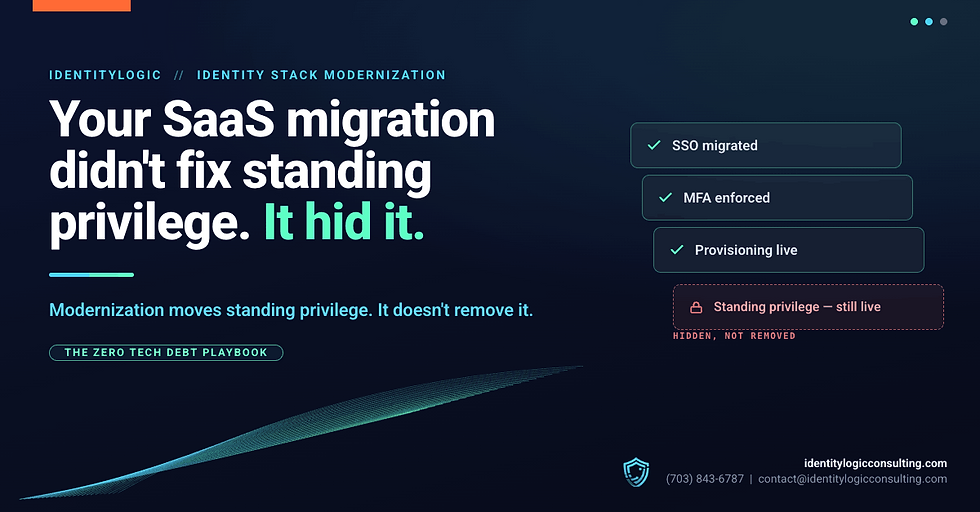
Most identity modernization projects end the same way. The legacy platform goes dark, the new SaaS tenant goes live, the migration team gets thanked, and everyone walks away believing the organization is more secure than it was a quarter ago. The architecture is newer. The vendor is modern. The dashboards are better.
The standing privilege you set out to eliminate is almost certainly still there.
Standing privilege is persistent, always-on access that sits available around the clock whether or not anyone is using it. It is the largest and most boring attack surface in most enterprises, and it is exactly what a modernization effort is supposed to reduce. Moving to a SaaS identity platform changes where that privilege lives. It does not, on its own, change how much of it is standing, always-on, and waiting to be abused.
The lift-and-shift trap
Here is how it happens, and it is rarely anyone's fault.
Migrations get scoped for parity. The mandate is "stand up the new platform and match what the old one did, by the deadline." That mandate is reasonable, and it is exactly the problem. Parity means you port the entitlement model instead of rebuilding it. Every over-provisioned role, every temporary admin grant that quietly became permanent, every orphaned account nobody owns, every group whose purpose was forgotten three reorgs ago: all of it gets faithfully re-created in the new tenant.

Take the most common modernization path we see, SailPoint IdentityIQ to Identity Security Cloud. A parity-driven migration lifts IIQ roles and birthright access and replicates them one-to-one into ISC access profiles. The result is a modern platform running a legacy access model. The same pattern shows up moving on-prem provisioning to Okta or Microsoft Entra ID, or a self-hosted vault to CyberArk Privilege Cloud.
The platforms are not the issue. SailPoint ISC, Okta, CyberArk, and Entra ID all support just-in-time access and zero standing privilege. But just-in-time is an architecture you design, not a default you inherit. If nobody makes that decision during the migration, the platform happily enforces the old model at higher availability.
Then it gets harder to see
The legacy stack at least had a chokepoint. Privileged access lived in a known place, behind a known system, that a known team reviewed.
A SaaS migration scatters it. Standing access ends up spread across tenant administrator roles handed out generously during cutover, integration accounts wired between systems to make the new platform talk to everything else, and OAuth scopes granted to connected applications that no one scheduled for review. The privilege did not shrink. It fragmented, and fragmentation reads as "gone" until someone goes looking.
The non-human identity multiplier
This is where the trap compounds, and it is the part most migration plans never budget for.
Every connector, sync account, API integration, and workload identity you create to make a SaaS identity platform function is a non-human identity. Each one carries standing access, often broad, frequently credentialed with secrets that are set once and never rotated, almost never offboarded when the integration it served is retired. A modernization effort does not add a handful of these. It multiplies them, faster than any team can govern by hand.

The identity-driven breaches that keep making headlines, from the Change Healthcare attack to the single sign-on compromises that have hit consumer platforms, share a through-line: an identity had standing access it did not need, and an attacker used it. After a migration, a disproportionate share of that unneeded access is sitting in service and integration accounts nobody is watching.
The fix window
The good news is the same fact stated differently. If a migration is the moment standing privilege gets carried forward, it is also the single best moment to leave it behind.
You are rebuilding the access model anyway. That is the one window where re-architecting toward least privilege is low-friction instead of a separate, hard-to-fund cleanup project competing with everything else on the roadmap. Skip it, and you inherit years of accumulated identity tech debt on day one of the new platform, then spend the next two years paying it down. Use it, and you go live clean.

That is the principle behind how we run these migrations. We call it Zero Tech Debt, layered on our delivery method.
Discover. Inventory the standing access that actually exists, human and non-human, before anything moves. Most organizations have never seen this list in full.
Design. Define the target least-privilege model and the just-in-time patterns for the access that does not need to be standing, rather than accepting the legacy model as the spec.
Build. Implement the new model in the new platform. We do not replicate the old entitlements. We build what the organization needs now.
Optimize. Tighten toward zero standing privilege, wire up continuous access review, and govern the non-human identities so they are rotated and offboarded like any other account.
The point is not that modernization fixes standing privilege. The point is that modernization is the opportunity to fix it, and that opportunity is either used or wasted.
There is no third outcome.
Who runs it matters
We have led these migrations as practitioners, not as a layer of management sitting above the work. The people who design the target model are the people in the build.
Our US and India global delivery model gives that work continuity without putting distance between you and the engineers doing it.
If you are planning a move to a SaaS identity platform, or you have already made one and suspect the old access model came along for the ride, the fastest way to find out is to look.
Schedule a free 30-minute IAM assessment call: identitylogicconsulting.com
Built by the people who ran it.


Comments